
MEET THE INSTRUCTOR
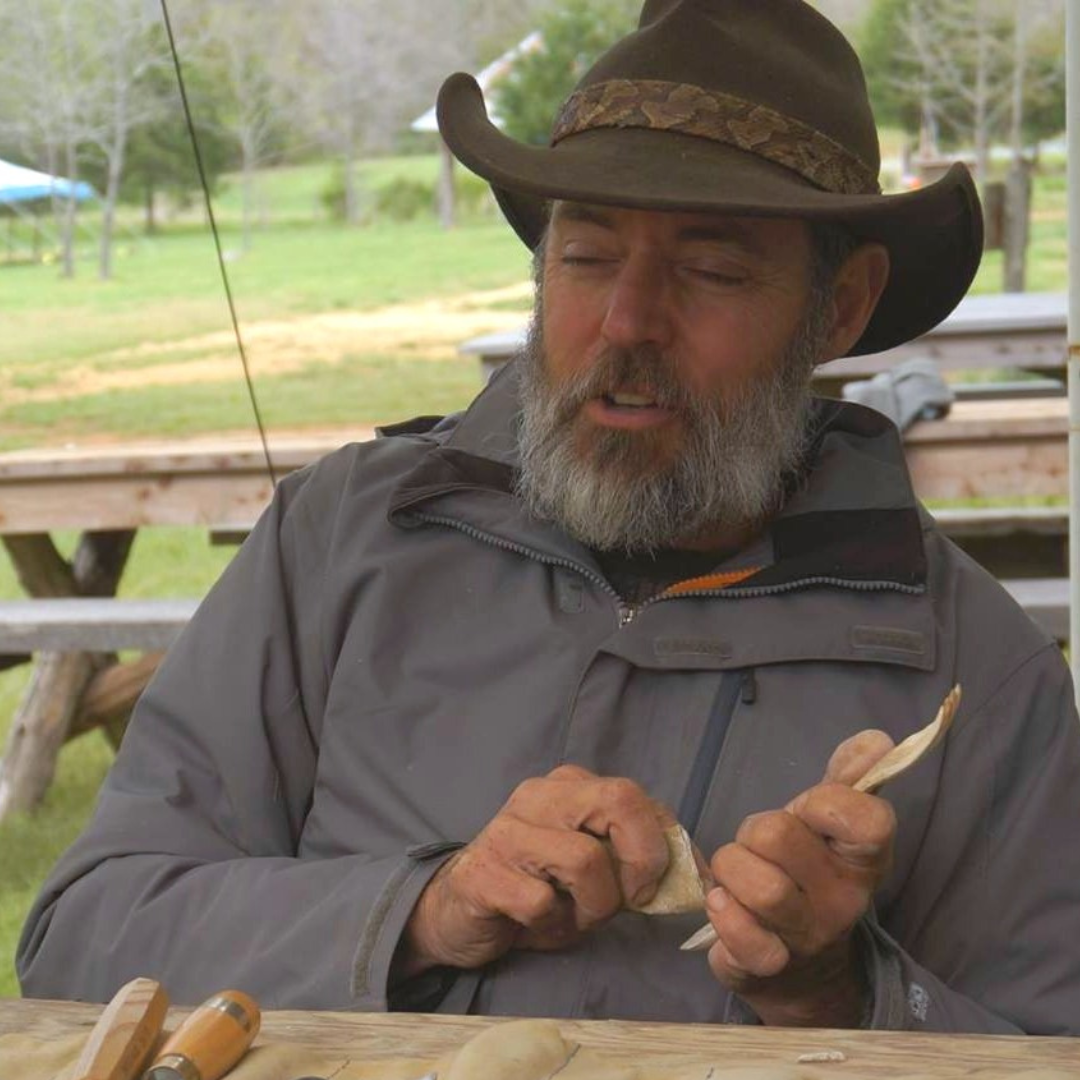
JEFFERY GOTLIEB
Traditional Skills Instructor
Preserving traditional knowledge by learning it, practicing it, and passing it on.
For more than three decades, Jeffery Gotlieb has worked as a naturalist, outdoor educator, author, and traditional skills instructor.
His experience reaches across natural history, traditional crafts, primitive technology, and outdoor education, with particular expertise in fiber arts, flintknapping, basketry, useful plants, nature awareness, and the construction of traditional shelters.
Throughout his career, Jeffery has taught children and adults through schools, nature centers, museums, scout programs, camps, historic events, and outdoor gatherings.
At Woodsrunner School, he brings something increasingly difficult to find: a lifetime spent studying, practicing, and teaching skills that have been passed from one generation to another.
A LIFE OF LEARNING AND MAKING
Knowledge That Passes Through the Hands
Some knowledge is best understood by reading about it.
Other knowledge has to pass through your hands.
For more than 30 years, Jeffery has devoted himself to understanding the natural world and the traditional skills people once depended upon as part of everyday life.
His work has taken him from studying plants and natural materials to flintknapping, basketry, fiber arts, shelter construction, and the reproduction of traditional tools and artifacts.
He is particularly known for constructing full-sized wigwams and longhouses and for carefully reproducing tools and objects that help people understand how earlier generations lived and worked.
For Jeffery, these aren't simply artifacts from the past.
They are opportunities to understand the relationship between people, materials, skill, and the natural world.
WHY HE TEACHES
Keeping Useful Knowledge Alive
Jeffery believes traditional knowledge is worth preserving—but preservation requires more than putting an artifact behind glass.
People have to learn the skills.
They have to handle the materials, understand how they behave, make mistakes, solve problems, and eventually create something with their own hands.
That is why teaching has remained such an important part of Jeffery's work.
His goal is simple: keep useful knowledge alive by putting it back into people's hands.
WHAT HE BELIEVES
Principles That Guide His Work
Traditional knowledge deserves to be preserved.
The best way to understand a skill is to practice it.
Nature provides both materials and lessons.
Good craftsmanship develops through patience and experience.
Questions are an important part of learning.
Skills become more meaningful when their history is understood.
Knowledge survives when someone is willing to pass it on.
A LIFETIME OF LEARNING
Science, Fieldwork, and Decades of Experience
Jeffery's education combines formal scientific study with decades of hands-on experience.
He holds a Master of Science in Biology, providing a strong academic foundation for his lifelong work as a naturalist and outdoor educator.
But much of Jeffery's education has also happened in the field—working with natural materials, studying plants, recreating traditional technologies, constructing shelters, teaching students, and learning from other craftspeople.
His travels throughout the eastern United States have taken him to rendezvous, gatherings, historic fairs, educational programs, and other places where traditional knowledge continues to be practiced and shared.
After more than three decades, he remains both instructor and student.
TEACHING PHILOSOPHY
See It. Touch It. Make It.
Jeffery believes traditional skills make the most sense when students can see them, touch them, and try them for themselves.
His teaching combines explanation, demonstration, history, natural science, and hands-on practice.
Students aren't simply shown a finished basket, cord, stone tool, or shelter.
They learn about the materials, where they come from, how they were used, and the process required to transform those materials into something useful.
That process matters.
Because making something with your own hands creates an understanding that simply reading about it cannot provide.
PROFESSIONAL BACKGROUND
Experience That Shapes the Work
Additional professional qualifications, publications, and related work are available separately.
AUTHOR & EDUCATOR
Preserving Knowledge in Writing
Jeffery's commitment to preserving traditional knowledge extends beyond the classroom.
He has written instructional resources designed to help both students and educators carry these skills forward, including a detailed manual on wigwam construction and Teaching Primitive Skills to Children.
He has also written about natural fibers and ropemaking, documenting techniques that transform materials gathered from the landscape into useful cordage.
Writing allows Jeffery to do the same thing his teaching does: preserve knowledge by making sure someone else can learn it.
BEYOND THE CLASSROOM
A Life Shaped by Traditional Skills
Traditional skills aren't simply subjects Jeffery teaches.
They are interests that have shaped much of his life.
Whether working with natural fibers, identifying useful plants, knapping stone, constructing a shelter, making a basket, studying natural history, or demonstrating a forgotten technique, Jeffery continues exploring the relationship between people and the natural world.
That curiosity has kept him learning for more than three decades—and continues to provide something new to share with his students.
LOOKING AHEAD
Traditions Survive Through Practice
Jeffery believes many traditional skills remain valuable precisely because they teach more than the finished task.
They develop patience.
They encourage observation.
They require people to understand materials rather than simply consume them.
And they connect today's students with generations of people who learned to make useful things from the landscapes around them.
His work at Woodsrunner School helps ensure those lessons aren't simply remembered.
They're practiced, taught, and passed on.
UNTIL OUR PATHS CROSS
Knowledge Survives When It Is Shared
Skills survive when they are practiced.
Traditions survive when someone takes the time to teach them.
There is always something more to learn from the woods.
— Jeffery Gotlieb